
Why is stainless steel used in mortuary and crematorium equipment?
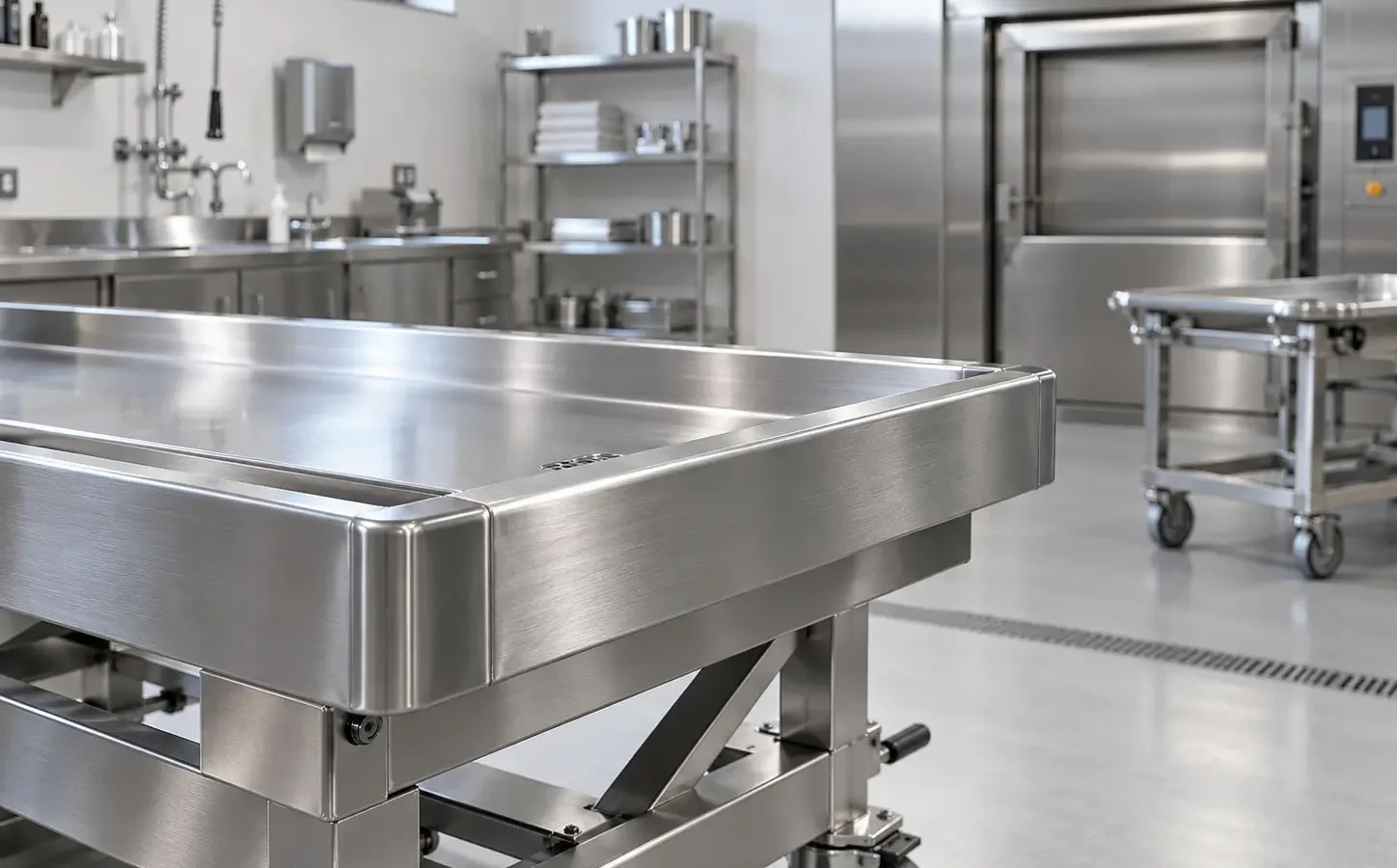
Stainless steel in mortuary equipment, crematoria and funeral homes is not chosen solely for its appearance. In a professional facility, the material must withstand regular use, frequent cleaning, exposure to moisture and repeated disinfection procedures. At the same time, surfaces should be as easy as possible to keep clean. This is why stainless steel is used for tables, trolleys, trays, cabinets and many other items of equipment. This does not mean, however, that all stainless steels perform identically or that they are completely resistant to every chemical. As a Polish manufacturer of stainless steel equipment, POLNIER pays attention to both the material and the construction of the finished product. It is therefore worth understanding what gives stainless steel its properties and how to care for it properly.
1. Stainless steel is not a single material
The term “stainless steel” covers a group of alloys with different properties. Individual grades differ in their chemical composition, resistance to specific environments and intended applications.
For professional equipment, an appropriate material specification and its suitability for the conditions of use are therefore more important than simply stating that a product is “made of stainless steel”.
For a specific product, the material grade should be stated in the manufacturer’s technical documentation.
2. What gives stainless steel its corrosion resistance?
One of the most important properties of stainless steel is its ability to form a very thin passive layer rich in chromium compounds on its surface.
This layer protects the material against many corrosion processes. Its presence is one reason why a suitably selected stainless steel can perform well in environments that require regular washing.
However, “stainless” should not be taken to mean “incapable of corroding”. Environmental conditions, unsuitable chemicals, surface contamination or prolonged contact with aggressive substances can affect the material’s resistance.
3. Why does a smooth surface matter?
With technical equipment, it is important that soiling can be removed efficiently from surfaces.
A properly finished stainless steel surface is durable and can be cleaned regularly. This is why the material is used for worktops, trays, tables, trolleys and housings, among other items.
However, the finish, the quality of the joints and the product’s geometry also matter. The material alone is no substitute for a properly designed structure.
4. Stainless steel performs well in equipment subject to intensive use
Professional equipment for mortuaries and funeral homes must withstand frequent use, movement, loading and cleaning.
A suitably specified steel structure makes it possible to produce durable trolleys, tables and technical furniture. For mobile equipment, the running gear, joints and maximum permissible load are, of course, also important.
A product’s durability should therefore not be judged on its material alone – its overall construction matters.
5. How should stainless steel equipment be cleaned?
The basic principle is to use products intended for the type of surface concerned and to follow the instructions of both the cleaning product manufacturer and the equipment manufacturer.
A typical procedure involves removing loose soiling, applying a suitably selected product, leaving it in place as instructed and then – if required by the product manufacturer – thoroughly rinsing and drying the surface.
Stubborn soiling should not be removed with unsuitable sharp tools or highly abrasive materials, as these can cause scratches.
6. Cleaning and disinfection are two different stages
In practice, the terms cleaning and disinfection are sometimes used interchangeably, although they serve different purposes.
Cleaning is primarily intended to remove soiling from a surface. Disinfection is intended to achieve a specific microbiological objective using a product selected for the procedure.
The disinfectant must also be compatible with the material on which it is used. Contact time, concentration and instructions for use should always be taken from the instructions for the specific product.
7. Is every disinfectant safe for stainless steel?
No. Resistance depends on the steel grade as well as the type of substance, its concentration, temperature, contact time and how the surface is subsequently rinsed.
Particular care is needed with products containing compounds that, under certain conditions, may increase the risk of localised corrosion, including in environments with a high chloride content.
Rather than assuming that “the stronger the product, the better”, use chemicals specified for the particular surface and procedure.
8. Why should you avoid unsuitable scouring pads and tools?
Highly abrasive materials can leave scratches on the surface. Another potential problem is contamination of the stainless steel with particles of ordinary carbon steel from unsuitable brushes or steel wool.
Such contamination can subsequently cause rust-coloured staining, even though the component itself is made of stainless steel.
Tools used to care for equipment should therefore be appropriately selected and clean.
9. The direction of the surface finish can also matter
Brushed surfaces have a visible grain direction. When cleaning by hand, it is worth following the manufacturer’s guidance on the direction in which to move the cleaning material.
This helps limit accidental, visible scratches across the grain and maintain a uniform surface appearance.
10. Product design affects hygiene as much as the material
A well-made table or item of technical furniture does not become hygienic simply because it is made of stainless steel.
Welds, joints, corners, access to surfaces and the reduction of areas where soiling can accumulate are also important.
That is why, when selecting professional equipment, it is worth examining the entire construction, not just the stated material.
11. Regular maintenance extends the period of proper use
Surfaces should be checked regularly for soiling, discolouration, deposits and mechanical damage.
If unusual marks appear, their cause should be identified rather than repeatedly applying increasingly aggressive products.
Sometimes the problem is an unsuitable chemical, sometimes a deposit left by water, and in other cases metal contamination or mechanical damage to the surface.
12. Where is stainless steel used in funeral equipment?
The material is used in many categories of professional equipment, including:
- tables for post-mortem cosmetic treatment and preparation,
- body transport trolleys,
- trays and accessories,
- cabinets and technical furniture,
- components of refrigeration systems and auxiliary equipment.
Each of these products serves a different purpose, so its construction and material requirements may differ.
13. What should you consider when buying stainless steel equipment?
It is worth asking not only about the material itself, but also about the product’s intended use, surface finish, cleaning method, permissible load and compatibility with other equipment.
For mobile products, the specifications of the running gear also matter. Dimensions are particularly important for trays, while for furniture, its layout and how it will be used in a specific room are important.
A more complete specification makes it possible to compare products on technical grounds, rather than appearance alone.
14. Polish manufacturer of stainless steel equipment
POLNIER manufactures specialist stainless steel equipment in Poland for crematoria, mortuaries and funeral homes.
Direct contact with the manufacturer makes it possible to discuss the intended application and the technical specifications of the product required. This is particularly important when several items – for example, a chamber, tray and trolley – need to work together.
View the full category of POLNIER stainless steel equipment.
15. FAQ – stainless steel and technical equipment
Can stainless steel rust?
Stainless steel has increased corrosion resistance, but it is not resistant to every possible environment. Unsuitable chemicals, chlorides, deposits, metal contamination or adverse conditions can cause surface problems.
What should be used to disinfect stainless steel?
Use products intended for the application and compatible with the particular surface. Always follow the product manufacturer’s and equipment manufacturer’s instructions on concentration, contact time and any required rinsing.
Can a scouring pad be used to clean stainless steel?
Unsuitable, aggressive abrasives and ordinary carbon steel wool are not recommended. They can scratch the surface or leave foreign metal particles on it.
Are all grades of stainless steel the same?
No. There are many grades with different compositions and properties. The appropriate material should be selected according to the product’s intended use and operating environment.
Does stainless steel alone guarantee that a product is easy to clean?
No. The equipment’s design is also very important: the construction of joints, corners and welds, and access to surfaces that require regular washing.
The material matters, but so does the whole product
Stainless steel is a good material for professional technical equipment when an appropriately selected grade is combined with suitable design, manufacture and use.
If you are looking for equipment for a crematorium, mortuary or funeral home, contact POLNIER and tell us about your intended application.


